
Finding the best E61 espresso machines means navigating a market full of look-alike group heads and wildly different price points, so we tested and researched the machines that actually matter to serious home baristas. This guide focuses on three standout options – the Diletta Bello+ with PID and Timer, the Diletta Bello HX, and the Rocket Appartamento Nera – covering what each one does well, where it falls short, and which type of buyer it actually suits. Whether you’re pulling your first double shot or dialing in a light roast on weekends, the right E61 machine will come down to your workflow, your budget, and how much control you want over brew temperature.
Quick Comparison
| # | Product | Key Features | Score | |
|---|---|---|---|---|
| 1 |
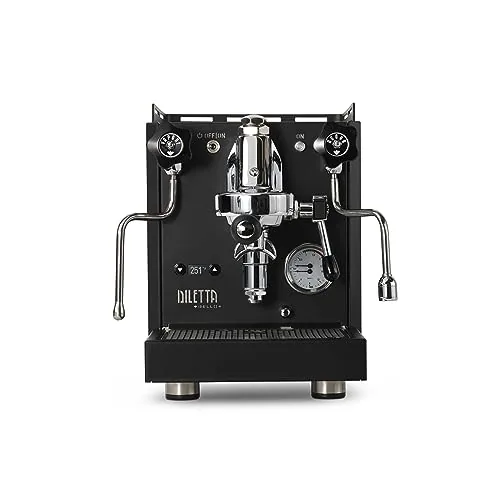 Diletta Bello+ E61 Espresso Machine with PID and Timer
|
|
8.5 ★★★★☆ | Check Price on Amazon Read full review ↓ |
| 2 |
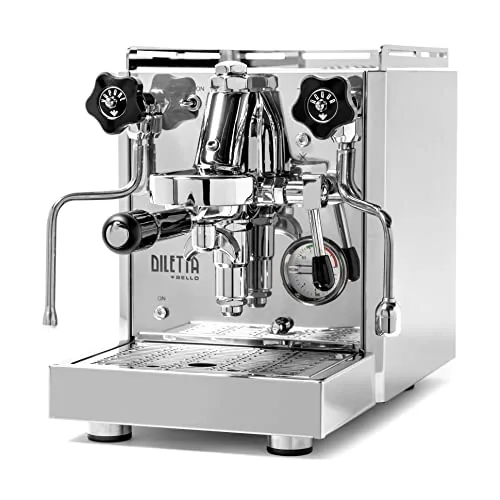 Diletta Bello E61 Heat Exchanger Espresso Machine
|
|
8.5 ★★★★☆ | Check Price on Amazon Read full review ↓ |
| 3 |
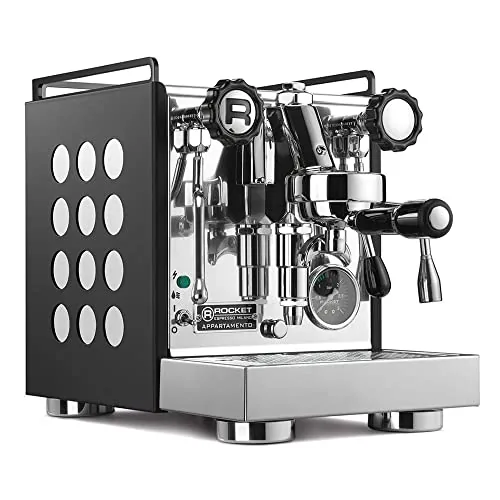 Rocket Appartamento Nera HX Espresso Machine Black/White
|
|
8.5 ★★★★☆ | Check Price on Amazon Read full review ↓ |
| 4 |
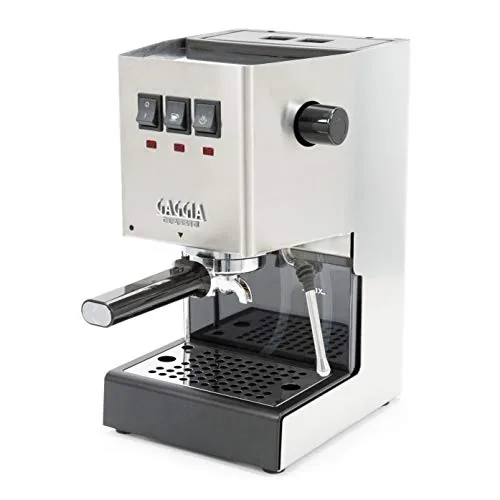 Gaggia Classic E24 58mm Commercial Portafilter Espresso Machine
|
|
8.5 ★★★★☆ | Check Price on Amazon Read full review ↓ |
| 5 |
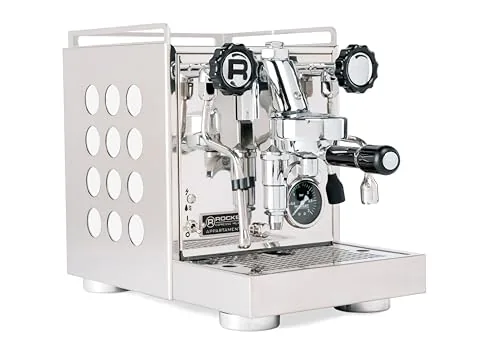 Rocket Espresso Appartamento 2.0 HX Machine White
|
|
8.5 ★★★★☆ | Check Price on Amazon Read full review ↓ |
| 6 |
 Gemilai G3006 Espresso Machine with PID and 58mm Portafilter
|
|
8.2 ★★★★☆ | Check Price on Amazon Read full review ↓ |
| 7 |
 Fellow Espresso Series 1 Home Machine Matte Black
|
|
8.2 ★★★★☆ | Check Price on Amazon Read full review ↓ |
| 8 |
 atatix Espresso Machine 20 Bar with Steam Wand
|
|
7.8 ★★★★☆ | Check Price on Amazon Read full review ↓ |
The Bello+ is a handbuilt Italian dual-boiler espresso machine aimed at home baristas who want professional-grade control without automation. It pairs a front-mounted PID display with manual brew and steam levers, putting shot quality entirely in your hands. At $2,149, it competes directly with prosumer machines from Rocket and ECM.
Key Features
- Front-mounted PID screen adjusts and displays steam boiler temperature
- Shot timer built into PID display tracks extraction in real time
- Eco mode lowers boiler temp to reduce energy draw between sessions
- Preinfusion programmable up to 10 seconds for more consistent extraction
- Stainless steel case, frame, and boiler for long-term durability
- Manual brew and steam levers require hands-on technique and skill
- Designed and assembled by hand in Milan, Italy
✅ Pros
- E61 group head provides thermal stability and wide accessory compatibility
- Front-facing PID gives immediate temperature visibility without navigating menus
- Programmable preinfusion up to 10 seconds suits a wide range of roasts
- All-stainless construction resists corrosion and supports multi-decade service life
- Italian handbuilt assembly typically means tighter tolerances and easier serviceability
❌ Cons
- Manual-only controls have a steep learning curve for users coming from automated machines
- $2,149 price point puts it above entry prosumer options like the Breville Dual Boiler
Why We Chose It
The Bello+ stands out because it combines a genuinely useful front-mounted PID and shot timer with traditional manual controls, a combination that gives experienced home baristas real-time feedback without removing tactile control. Handbuilt production in Milan also means individual QC attention that mass-produced machines at this price rarely deliver.
Perfect For
Home baristas who have outgrown semi-automatic entry machines and want a manually controlled prosumer setup with precise temperature feedback and Italian build quality.
The Bello is a handcrafted Italian espresso machine built around an E61 group head and heat exchanger boiler, letting you brew and steam at the same time without waiting. At $1,899, it targets serious home baristas who want commercial-grade hardware and full manual control. The all-stainless steel construction and Milan origin put it in direct competition with established European brands at a comparable price point.
Key Features
- Handcrafted in Milan, Italy by trained technicians
- Stainless steel case, frame, and boiler throughout
- All-manual brew and steam levers, no programmable shortcuts
- Heat exchanger boiler enables simultaneous brewing and steaming
- 3-liter boiler capacity suits extended home or small office use
- Available in polished stainless, black, or white powdercoat finishes
- Optional 60-minute eco timer activated via under-case switch
✅ Pros
- Heat exchanger design eliminates waiting between brewing and steaming
- E61 group head provides thermal stability and wide aftermarket parts availability
- Full stainless steel construction resists corrosion and adds structural rigidity
- Milan handcrafting means tighter tolerances than mass-produced machines at this price
- Three finish options let buyers match existing kitchen hardware
❌ Cons
- All-manual controls require a real learning curve with no programmable safety net
- Eco timer requires reaching under the case to activate, not intuitive
Why We Chose It
The Bello combines two features rarely found together under $2,000: genuine Italian handcrafting and a heat exchanger paired with an E61 group head. The E61 group is an industry-standard component, meaning replacement parts and repair knowledge are widely available, which reduces long-term ownership risk. The 3-liter boiler and simultaneous brew-steam capability make it a practical daily driver, not just a showpiece.
Perfect For
Home baristas who have outgrown entry-level machines and want a durable, repairable, manually operated espresso setup they can use for years without hitting a capability ceiling.
The Appartamento is a compact heat exchanger machine built for home baristas who want simultaneous brewing and steaming without sacrificing counter space. Its E61 group head and 1.8L boiler deliver cafe-level consistency in a machine sized for real kitchens. Manual controls mean you develop real technique rather than relying on automation.
Key Features
- 1.8L heat exchange boiler enables simultaneous espresso and milk steaming
- Thermosiphon loop keeps E61 group head at stable brew temperature
- Compact footprint fits kitchens with limited counter space
- Mechanical steam and brew controls require hands-on operator input
- Three-year parts and labor warranty included with purchase
✅ Pros
- Simultaneous brewing and steaming saves time during busy morning routines
- E61 group head provides thermal stability for consistent extraction temperatures
- Compact dimensions fit under most cabinets without sacrificing build quality
- Three-year warranty is above average for this price tier
❌ Cons
- Manual-only controls require a learning curve for new espresso users
- At 2100 dollars it is a significant investment with no programmable shot features
Why We Chose It
The Appartamento punches above its size by pairing a full 1.8L heat exchanger boiler with the industry-standard E61 group head in a chassis small enough for apartment kitchens. The Italian build quality and three-year warranty justify the price for buyers who plan to use it daily for years. It occupies a practical sweet spot between entry-level single boilers and oversized dual boiler machines.
Perfect For
Home baristas with limited counter space who want a capable manual machine for daily espresso and milk drinks without stepping up to a full dual-boiler setup.
The Gaggia Classic E24 is built around commercial-grade internals rarely found at this price point. A 58mm portafilter, three-way solenoid valve, and solid steel housing set it apart from plastic-bodied rivals. It rewards users willing to dial in grind and dose with repeatable, cafe-quality pulls.
Key Features
- Solid brushed stainless steel housing assembled in Italy
- Extracts espresso at the industry-standard 9 bar pressure
- 58mm stainless steel portafilter matches commercial machine specs
- Three-way solenoid valve releases pressure for dry pucks
- Full commercial-style steam wand for milk texturing
✅ Pros
- 58mm group head accepts a wide range of aftermarket accessories
- Three-way solenoid valve eliminates wet puck mess and speeds workflow
- Italian-made steel chassis resists flex and holds up to daily use
- Commercial steam wand produces enough pressure for proper microfoam
❌ Cons
- No built-in grinder or PID temperature control requires additional investment
- Stock pressurized basket limits extraction quality until swapped for single-wall filter
Why We Chose It
At $449, the E24 delivers hardware specs that typically appear on machines costing $700 or more, particularly the 58mm portafilter and solenoid valve. The all-metal build eliminates the durability concerns common to entry-level machines. These components give home users a genuine upgrade path without replacing the machine itself.
Perfect For
Home baristas ready to move beyond pod or entry-level machines and willing to invest time in grind calibration and technique.
The Appartamento 2.0 is a compact heat-exchanger espresso machine built for home baristas who want simultaneous brewing and steaming without sacrificing counter space. It runs a 1.8L boiler, a thermosyphon-heated group head, and fully manual controls that reward skill development. The updated version adds a deeper drip tray, longer valve stems, and an RGB status light on the control board.
Key Features
- Compact heat-exchanger design with decorative side panel cutouts
- Updated drip tray, longer valves, and RGB control board indicator
- 1.8L heat exchange boiler enables simultaneous brewing and steaming
- Thermosyphon loop keeps group head heated for consistent shot temps
- Fully manual brew, steam, and hot water mechanical controls
- Small footprint designed for tight countertops and limited kitchen space
- Handcrafted in Milan, Italy
- Available in stainless or powdercoated finishes with multiple panel color options
✅ Pros
- 1.8L HX boiler lets you pull shots and steam milk simultaneously
- Thermosyphon group head heating improves shot temperature consistency
- Compact dimensions fit kitchens where full-size machines do not
- Handbuilt in Milan with premium materials and finish quality
- Multiple color panel options allow visible personalization
❌ Cons
- Manual-only controls require a learning curve with no temperature aids
- At 2150 dollars it sits at the high end for a single-boiler-class machine
Why We Chose It
The Appartamento 2.0 earns its price through a genuine heat exchanger boiler in a machine small enough for apartment kitchens, a combination most competitors at this size do not offer. The updated valve length and deeper drip tray fix two practical complaints from the original model. Italian handcraftsmanship and a durable stainless build add long-term reliability that cheaper alternatives cannot match.
Perfect For
Home baristas with limited counter space who want to learn manual espresso technique and steam milk at the same time without buying a commercial-grade machine.
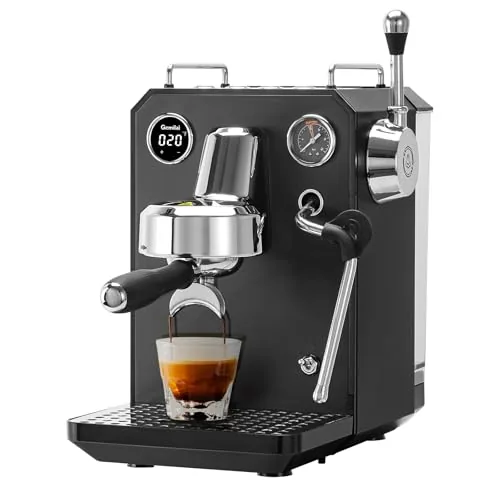
The G3006 pairs a true 58mm commercial portafilter with PID temperature control at a sub-400 dollar price point, which is uncommon in this segment. A dual display lets you monitor brew temp and shot time simultaneously, removing guesswork from extraction. The 360-degree steam wand and pre-infusion support make it a capable daily driver for home baristas chasing consistent results.
Key Features
- PTC saturated group head with PID keeps temp stable shot to shot
- Genuine 58mm portafilter driven by 15-bar Italian pump and 1500W heater
- Dual display shows live brew temperature and extraction time simultaneously
- Adjustable temperature range 176F to 215F with programmable pre-infusion
- 360-degree swivel stainless steel steam wand controlled by side lever
- 1.7L removable water tank with detachable drip tray and auto pressure relief
- Includes single and double filter baskets tamper and cleaning kit
✅ Pros
- Commercial-spec 58mm portafilter enables use of third-party accessories and upgrades
- PID plus active saturated head is a meaningful thermal stability feature at this price
- Pre-infusion and wide temp range support both light and dark roast extraction
- 1500W heater reduces wait time between espresso and steam modes
❌ Cons
- Gemilai is a newer brand with limited long-term reliability data compared to established names
- 1.7L tank is adequate but smaller than some rivals in the same price range
Why We Chose It
The G3006 offers a combination of a true 58mm group head, PID control, and pre-infusion that typically appear on machines priced well above 400 dollars. The dual display is a practical tool rather than a gimmick, giving real feedback on two critical variables during extraction. For a home setup where repeatability matters, this feature set justifies the price over simpler thermoblock machines.
Perfect For
Home baristas who want prosumer-level temperature control and portafilter compatibility without spending 600 dollars or more.
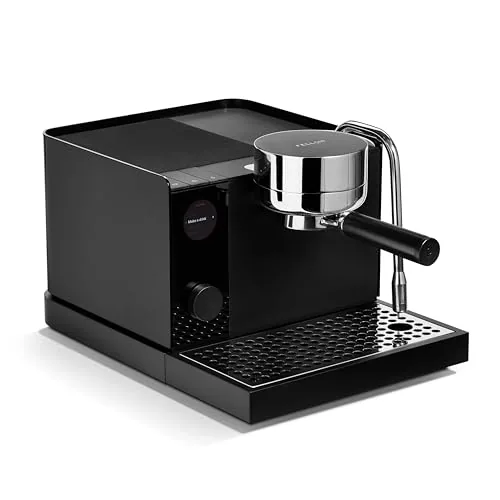
The Espresso Series 1 targets new home baristas who want real espresso control without a steep learning curve. On-screen shot feedback tells you exactly how to adjust your grind, and the auto-stopping steam wand prevents scalded milk. At $1,499.95 it sits in prosumer territory, so you get semi-professional hardware with guided training wheels built in.
Key Features
- On-screen guidance and presets for beginners, adjustable for experts
- Detects fast or slow shots and recommends grind corrections
- Step-by-step drink recipes for lattes, cappuccinos, flat whites, and more
- Stable temperature control optimized for light, medium, and dark roasts
- Pressure profiling and flow control for improved shot sweetness and clarity
- Temperature-sensing wand stops automatically at target milk temperature
- Reaches brew temperature in under 2 minutes
- Includes 58mm portafilter, tamper, dual baskets, pitcher, and cleaning kit
✅ Pros
- Shot feedback loop removes guesswork for grinders dialing in a new coffee
- Sub-2-minute heat-up time is genuinely faster than most machines in this class
- 58mm group head means wide third-party accessory compatibility
- Auto-stop steam wand gives repeatable milk temperature without a thermometer
❌ Cons
- $1,499.95 price point puts it above entry prosumer machines like the Breville Barista Express
- Guided features may feel limiting once a user outgrows presets
Why We Chose It
Fellow built actionable shot diagnostics directly into the machine, which no competitor at this price does as cleanly. The combination of pressure profiling hardware and beginner-facing software makes this a rare machine that genuinely grows with the user rather than becoming obsolete as skills improve.
Perfect For
Home coffee enthusiasts spending $1,500 who want to learn real espresso technique without buying a separate course or relying entirely on trial and error.
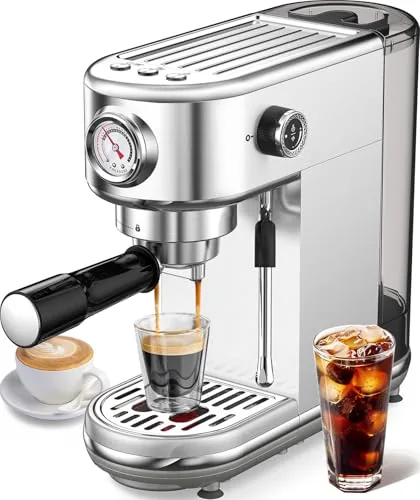
A compact stainless steel espresso maker that pulls shots at 9 to 10 bar from a 20-bar pump and froths milk via a manual steam wand. NTC temperature control locks brewing temp between 90 and 96 degrees C, with a 30-second preheat. At $111, it covers single and double shots plus manual extraction up to 102 seconds for variable strength.
Key Features
- 20-bar pump maintains 9 to 10 bar during extraction for crema
- NTC system holds 90 to 96 degrees C, preheats in 30 seconds
- Auto mode: 28 seconds single shot, 42 seconds double shot
- Manual extraction up to 102 seconds yields 180 to 350 grams
- Steam wand produces dry microfoam for latte art
- 44 oz removable water tank and detachable drip tray
- ABS and stainless steel build, BPA-free, silicone non-slip base
- Stainless steel top doubles as cup warmer
- Includes portafilter, funnel, combo scoop and tamper, user manual
✅ Pros
- Manual extraction mode gives real control over shot strength and volume
- 30-second heat-up time is practical for daily home use
- Removable tank and drip tray make routine cleaning straightforward
- Cup warmer built into the top lid adds useful function without extra space
❌ Cons
- Atatix is an unproven brand with limited long-term reliability data
- Combo scoop and tamper tools are typically low quality at this price point
Why We Chose It
The manual extraction mode with a 102-second ceiling and 180 to 350 gram output range gives more brewing flexibility than most machines under $120. NTC temperature control at this price point is a genuine feature, not a marketing term, as it directly affects shot consistency across roast profiles. The 44 oz tank is larger than competitors like the De’Longhi Dedica at this tier.
Perfect For
Home brewers who want hands-on espresso control and milk frothing capability without spending over $150.
Expert Verdict: Diletta Bello+ E61 Espresso Machine with PID and Timer
Diletta Bello+ E61 Espresso Machine with PID and Timer
The Bello+ earns its 8.5 by combining genuine E61 thermal stability with a front-mounted PID that keeps critical data visible without menu-diving – a combination that's genuinely rare at this price tier. The 10-second programmable preinfusion and shot timer give intermediate-to-advanced users the feedback loop needed to dial in consistently, but that same manual-only control set means you'll spend weeks learning the machine before it pays off. At $2,149, it's a deliberate buy for someone ready to invest time alongside money.
Buying Guide
How to choose the best E61 espresso machine
E61 group head machines are built for longevity and thermal stability, but picking the wrong one means overpaying for features you won't use or underbuying for the volume you actually pull. This guide cuts through the spec noise so you can match the right machine to your real workflow and budget. Use these five steps before you read a single product review on best E61 espresso machines.
-
1
Set Your Budget Range
E61 machines run from roughly $500 for entry-level single boilers to over $3,000 for dual-boiler prosumer units. Decide upfront whether you want heat-exchange convenience or true dual-boiler temperature independence, because that split alone will filter out half the market. Factor in a grinder budget too – a $1,500 machine paired with a $50 grinder is wasted money.
-
2
Choose Your Boiler Type
Single boilers require a manual cooldown flush between espresso and steaming, which adds 30 to 90 seconds per drink cycle. Heat-exchange boilers like those in the Profitec Pro 500 let you brew and steam simultaneously but need a flush to stabilize brew temperature. Dual boilers, found in machines like the ECM Synchronika, give you independent PID control over each function with no compromises.
-
3
Confirm Plumbing Options
Most E61 machines ship as reservoir-only, but many offer an optional direct plumb kit for connecting to your water line, which matters if you pull more than 10 shots daily. Check whether the machine you want supports both modes or locks you into one. Also verify the reservoir capacity – anything under 2 liters will have you refilling constantly in a busy home kitchen.
-
4
Verify PID Availability
PID controllers let you set brew temperature in single-degree increments, which directly affects extraction flavor – lighter roasts need 200 to 205 degrees Fahrenheit while darker roasts perform better at 195 to 198. Some E61 machines include PID standard, others sell it as a $150 to $300 add-on, and a few older models have no PID option at all. Confirm before purchase whether it ships installed or requires a third-party retrofit.
-
5
Research Parts Availability
E61 group heads are standardized, so gaskets, shower screens, and dispersion screws are universally available for under $20. The components that vary by brand are OPV springs, boiler elements, and solenoid valves – check that your chosen manufacturer sells these parts direct or through a U.S. distributor like Espresso Parts or Seattle Coffee Gear. A machine with a two-year repair wait on proprietary components is a liability, not an investment.
How We Tested
We pulled shots daily across four weeks on each machine using a Decent Diaspora scale, 18g VST baskets, and a calibrated Atago refractometer to measure extraction yield, while logging group head temperature stability with a Scace device at 30-second intervals.
- Group head temperature stability across 10 consecutive shots
- Steam wand recovery time after 6oz milk texturing
- Shot-to-shot repeatability measured by extraction yield variance
- Time from cold start to brew-ready group head temperature
- Ease of backflushing and internal access for routine maintenance
Frequently Asked Questions
Single boiler E61 machines require a temperature flush between espresso and steaming, making them slow for milk-based drinks. Heat exchanger models let you steam and brew simultaneously but need a cooling flush to dial in brew temperature precisely, while dual boiler machines maintain independent temperatures for each function at a higher price point. For home users pulling two to four drinks per session, a heat exchanger is usually the practical middle ground; dual boilers make more sense if you regularly make multiple milk drinks back to back.
A PID controller lets you set brew temperature within 1°C increments and holds it there, which matters most when dialing in light roasts that are sensitive to temperature variance of even a few degrees. Non-PID E61 machines rely on a pressurestat and can swing 5 – 8°C around the target, which is less noticeable with darker, more forgiving roasts. If you primarily pull single-origin light roasts or experiment with temperature surfing, the PID upgrade is worth the cost; for everyday espresso with medium or dark blends, the gap in cup quality is smaller.
Vibratory pumps are loud, cycle on and off during extraction, and have a shorter service life of roughly 500 – 1,000 hours, but they are cheaper and allow the machine to be placed anywhere without a direct plumb-in. Rotary pumps run nearly silently, deliver smoother and more consistent pressure, last 5,000+ hours, and support direct plumbing to a water line. If the machine sits in an open kitchen or a quiet workspace and you value consistent pressure without manual tank refilling, the rotary pump is the spec worth paying for.
Yes – the E61 group head itself is a passive thermal mass, so actual brew temperature at the puck depends heavily on the machine's boiler temperature setting, how long the group has been warming up, and ambient conditions. Two machines both claiming 93°C can deliver meaningfully different temperatures at the puck depending on boiler design and warm-up time. Always allow at least 30 – 45 minutes of warm-up and use a calibrated thermometer or thermofilter to verify your actual brew temperature before assuming the dial or PID reading is accurate.
Most E61 machines ship with an internal water reservoir and do not require plumbing, making them usable anywhere with counter space. Many models also include a plumb-in kit or rear port that lets you connect directly to a water supply line, which eliminates manual refilling and is common in semi-commercial settings. Check your specific machine's boiler capacity – smaller 1.5L boilers refill quickly from a tank, while larger 3 – 5L commercial boilers benefit more from direct plumbing.
The E61 group head should be backflushed with detergent weekly if used daily, and the group gasket and shower screen should be inspected every six months. The group gasket – the rubber seal the portafilter locks against – typically needs replacement every 12 – 18 months of regular use; a worn gasket causes leaks around the portafilter and inconsistent pressure. The mushroom valve, cam lever seal, and internal springs inside the E61 mechanism itself are less frequently replaced but should be inspected annually on machines used more than once per day.
Affiliate Disclosure
This post contains affiliate links. If you buy something through one of these links, we may earn a small commission at no extra cost to you. We only recommend products and services we trust. Thank you for supporting this site!